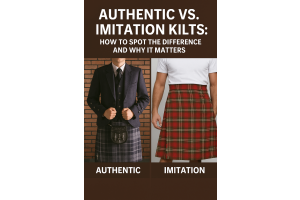



No European garment has been as romanticized in history and fiction as the kilt. It is the garb of heroes and freedom fighters from the northern Highlands to the southern borders that touch the northern edges of Great Britain. Scottish royal and noble families wear the symbols of their great houses woven into the very fabric of their kilts. Hand-made and hand-woven kilts are highly prized by their owners and treated with the utmost care when stored.
While many people around the world recognize kilts on sight, few actually know how a kilt is made. Moreover, far fewer still know the strict rules and requirements for crafting a true kilt. Here at Kilt Rental USA, we cherish both the history and craftsmanship of kilts and kilt making. As part of our respect and celebration of the noble kilt, we have assembled a guide to kilt making. Along the way, we’ll discuss some of the history of kilt making and why certain practices are still in use today.
What Is A Kilt?
Knowing what gives a kilt its unique identity is an excellent starting point for any guide to how kilts are made. Officially, a kilt is a plain front, belted and pleated skirt worn at or above the waist. A true kilt must not break the pattern of the tartan, and it is for this reason that they typically use between six and eight yards of worsted wool. A sporran, or traditional leather purse, is usually worn at the front to carry money or provisions when out and about in the Highlands.
In the early days predating the kingdoms of England, kilts were made using at least eight yards of fabric and belted at the waist with a broad leather or cloth belt. The excess length was wrapped over the shoulder and fastened with a torc (a large metal ring with a pin) or brooch. Its original purpose was to serve as both a garment and a blanket used to wrap oneself against the cold when sleeping outdoors.
Traditional kilts were put on lying down to wrap the skirt portion around the waist securely. Most men wore a long linen shirt in addition to the kilt, though in hot weather many went without. After wrapping it around their waist, Scotsmen secured their kilt with both a belt and torc. The tartan, or dye pattern, didn’t come into fashion until the 17th century. It’s purpose was to identify the family or loyalty to each clan or family like a uniform. The colors used to dye tartan came from local plants, so the colors and patterns are unique to each region or family holding.
The popularity of the waist length kilt didn’t come about until the 18th century. It was the garb of choice for freedom fighters and Scottish nationalists who supported an independent Scotland. Prior to that time, kilts were only worn by Highlanders or those who lived out in the country away from the cities. Now that we know something about the history and origin of the kilt, let’s look at how they are made.
How Kilts Are Made
There is a traditional process to making a kilt that hasn’t changed much over the centuries. Let’s begin with the materials and measurements.
Materials
A kilt requires the following amount of tartan worsted wool to make a proper kilt:
- 21 inches at either end for the inside and outside apron (plain fronted sections where the kilt is belted or buttoned. (42 inches total)
- 21 inches of pleating at nine inches per pleat (the tartan is cut in 8 inches so as not to break the sett or pattern). (189 inches)
- Add 20% of the total length for additional pleating and centering the pattern of the apron. (46 inches)
- Total inches of tartan needed: 277 inches
The total length is then divided by 72, and you have an approximate yardage for the fabric. The average modern pleated kilt requires approximately 4 yards of fabric sixty inches wide. If the sett is shorter than 8 inches, then less tartan is required.
Step 1: Measuring The Customer
To get the correct waist size, the first measurement should be taken around the waist at the top of the hip bone. The second measurement is taken from the top of the hip bone to the widest part of the hip. Finally, the length of the kilt is determined by having the customer kneel and measuring the distance from the top of their hip to the floor.
Step 2: Selecting the Tartan
The customer will choose a tartan for their kilt, with the craftsperson checking to see if it is symmetrical or asymmetrical. Chalk is used to mark the fabric for stitching.
Step 3: Pleating
This is the most important step for making a kilt, and requires the highest degree of skill. The majority of the fabric will be used in the pleating. Larger kilt wearers will need up to nine yards of tartan to make a proper, symmetrical kilt. Pleat length is determined by the tartan and whether the kilt will be regimental (measuring to the stripe), or traditional (to the sett). Patterns with smaller checks create smaller, shorter pleats, and large checks create larger, deeper pleats.
Step 4: Belt & Buckles
Once the pleating is finished, belt loops are added for the kilt if needed. Loops for belted kilts tend to be quite wide to accommodate traditional broad leather belts. They are usually stitched by hand and finished above the pleats to match the tartan.
Step 5: Belt Buckles
The under buckle is stitched securely a pleat back from the vent of a kilt. The upper buckle is stitched at the specific waist measurement for the wearer and should match the sett precisely. When worn, both buckles should line up precisely with the design features of the kilt.
Step 6: Leather Straps
Each kilt has two to three leather straps with five holes each for adjustment. This doesn’t leave a lot of room for error, and careful measuring and stitching is required. A high quality kilt always has the straps and buckles matched and stitched exactly to keep them lined up to the sett.
Step 7: Final Fitting
After the straps and buckles have been added, it’s time for a final fitting to ensure that everything falls and fits to the wearer’s comfort and satisfaction. This is also the best time to select accessories for wearing the kilt, such as a sporran and stockings.
Kilt making is a time-honored and time-consuming tradition. Hopefully this guide has given you insight into making kilts, and why purchasing one is a lifetime investment. The team at Kilt Rental USA understands the significance of making and wearing kilts. For these reasons, all of our products are made to the highest standards and sourced responsibly. If you have a kilt-wearing occasion to attend, contact us today. Our staff is dedicated to the traditions and importance of kilt-wearing. We are ready and eager to help you find the perfect fit for any occasion.