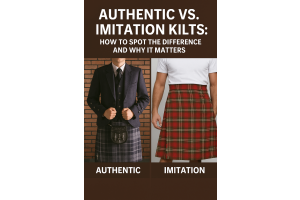



As national symbols go, none are so storied as the Scottish kilt. It is the national garment of Scotland, and it has been worn for a vast number of reasons: to show respect, a fashion statement and even as a symbol of government protest. Kilts are still lovingly handmade and worn today for different reasons, but the tradition is deep in the bones of the people of Scotland.
Many people know that kilts are Scottish, but there are many secrets of kilts that are known only to kilt aficionados. Today, we initiate our gentle readers into the top ten secrets of kilts. Read on to learn the greatest secrets of the kilt-wearing cognoscenti.
Secret #1: Kilts Are Precious Heirlooms In Scotland
Kilts are far more than just “dresses/skirts for men”. They have hundreds of years of tradition and craftsmanship going back to before the founding of the first kingdoms of England. Many kilts are heirlooms passed down between generations, and each has a story all its own. Everything from the color and pattern to the style has deep cultural and familial significance. Many Scots who have inherited kilts from their ancestors take great pride in telling the stories of their family and the kilt itself.
Secret #2: The Word Kilt Is NOT Scottish
Believe it or not, the word kilt is actually derived from the Old Norse word kjilt, which roughly translates to “pleated”. It was used to refer to any clothing wrapped around and over the body. Norse vikings raided lands all over the northern coasts of Scotland, and even established settlements there. It is one of history’s great ironies that the symbol of Scottish nationalism has its roots in the language of the vikings.
Secret #3: Kilts Have Only Been On Record For Six Hundred Years
The Scottish have worn kilts for time immemorial, but the first recorded mention of kilts wasn’t until 1538. They were full-length garments worn by the Gaelic-speaking Scottish Highlander men, and were common dress for the indigenous people. Knee length kilts as we know them today didn’t actually come into fashion until the early 18th century. This is largely due to the fact that kilts were considered the dress of wild Highlanders, and not decent folk.
Secret #4: Kilts Did Not Originally Have Tartans
Prior to the formal establishment of local clans, kilts did not have tartans. They were made of white, brown, green or black worsted wool. As time went on, the clan kilt makers used plants, berries and mosses to dye the woolen thread before weaving. The color of these threads was determined by what dyes were available locally, and weavers created unique patterns in their cloth. Eventually the local patterns became the symbols of each region or clan, and the tartan cloth was born.
Secret #5: Kilts Were Not Popular Until The 1700s
The heyday of the kilt was during the 18th century, when Highlander men began to wear them as a symbol of Scottish pride and family loyalty. These “great kilts” were considered a sign of wealth, and there was even a version for women referred to as the tartan wrap. Tartan wraps fell to the ankles, and were made from white tartan cloth with widely spaced patterns.
Secret #6: Short Kilts Were Not Worn Until The 17th Century
The small kilt, also called a phillabeg, wasn’t worn until the latter years of the 17th century. These kilts had two pieces of cloth, with the bottom half gathered in pleats and belted at the waist. The lower half fell to the knee, and a separate cloth was worn over the shoulder to keep the wearer warm.
Secret #7: A Ban On Kilts Made Them Popular
King George II, as a means of bringing the Highland people and its culture to heel under English rule, banned kilts in 1746. Called the Dress Act, it made the wearing of kilts or any other form of Highland dress. Scottish regiments were not permitted to wear their tartan kilts, some of which had included kilts as part of regimental dress for centuries.
Opponents of King George plotted to replace him via Jacobite armies, and he hoped to use the ban to root out supporters. They were called Jacobites because they supported the restoration of the House of Stuart/Stewart and Prince James Francis Edward Stuart to the British throne. Jacobus is the Latin form of James, and so his supporters were called Jacobites. The English King thought that if he banned kilts in the army and in public would reveal the Jacobites in his ranks. Ironically, the Dress Act had the opposite effect.
Even people who did not support the Jacobites began wearing kilts to protest the oppression of their culture by England. This led to the lifting of the ban in 1782, a thirty-six-year span of useless and pointless legal oppression.
Secret #8: The Dress Act Established The Kilt As A National Symbol
After the ban was lifted, the kilt would forever be fixed in the national consciousness as a symbol of Scottish independence from England. Tartan patterns were formally established for clans, families and regions. Today, there are over 3,500 tartan family plaids. A kilt can take up to 20-25 hours to make by hand, and true kilts must have unbroken tartan patterns. There are 29 pleats in the average kilt, and each kilt uses anywhere from eight to nine yards of fabric.
Secret #9: Sporrans Were Not Just For Looks (And Kilts Have Required Accessories)
Any self-respecting kilt wearer would not be seen in public without a sporran. The name is a Gaelic word meaning “purse”, and it is always worn around the waist and over the kilt. Sporrans were like oversize wallets for keeping money, provisions, and even extra powder and shot for a firearm.
Additionally, great kilts must be fastened with a pin or torc (metal ring with a pin) to secure them properly. Finally, kilts must be worn with long socks to accommodate a Sgian dubh (skee-an doo), which is a dagger small enough to conceal in a sock. Sgian dubgh were holdout weapons of last resort that every Highlander carried with them as both a weapon and a utility knife. They are considered essential to proper Highland dress.
Secret #10: What Does A Scotsman Wear Beneath His Kilt?
This is a subject of stories and songs for time out of mind: what do Scotsmen wear under their kilts? According to a recent government survey, 55 percent of kilt-wearing men stated they wear dark underwear, 38 percent wear nothing at all, and 7 percent wear shorts or tights.
The survey went on to find that 91 percent of Scottish women find kilt-wearing men attractive. Moreover, 67 percent of men believe it is strong and patriotic. Unsurprisingly, an overwhelming majority of women interviewed also said they think that nothing at all should be worn underneath a kilt.
We hope you find our secrets of the kilt as entertaining and informative as we do. Armed with this knowledge, you can now sport a kilt with the best of them. You can also rest easy in your knowledge that you are keeping the Highland ways alive and well for future generations. Are you in need of a kilt for a wedding or sporting event? Contact us today for more information about our kilt rental services, and how to go about finding the perfect kilt for your event or special occasion.