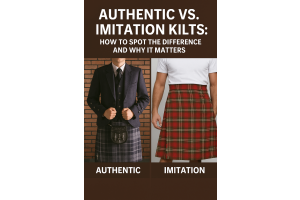



If you’re wondering what a traditional Scottish outfit looks like, you’re in the right place to find out.
At Kilt Rental USA, you can trust us when we say that we know what we’re talking about. We’ve been advising people much like you and supplying kilts for over 15 years.
With that said, what does a traditional Scottish outfit look like?
Well, It can vary. But it usually has a simple template, sort of speak, so we’ll focus on that.
We’ll be looking at all of the common pairings of shirts, kilts, sporrans and all the accessories.
Then, by the end of this article, you don’t only know what it looks like in a formal setting, you’ll also know what it looks like in a casual setting.
Now that we have our focus let’s begin at the obvious place.
Kilts
Fair warning, we’ll be diving into a lot of the details of these.
The modern Scottish kilt is a type of cloth garment worn in Scotland, which has its origins in the traditional men's dress of the small nation. The Scots kilt takes its name from a Gaelic word for "the fold", but it also resembles two other forms of skirt-like attire, namely the English pleated skirt and the Irish kilt.
These garments are similar in style and design, with an overlapping gored pattern produced using thick ridges achieved by folding and pressing together broad tapes made from tartan fabric. Many people assume they all come under the general term "Scots" kilt.
However, despite their visual similarities, there are some notable differences.
With that clarification, we’ll start with the first type of Scottish kilt.
The casual kilt.
The casual kilt, also known as the 5-yard kilt, is usually the go-to for any type of non-formal event. It’s a relatively inexpensive option, but despite that, it can still be dressed up if need be.
They sit lower on the waist than an 8-yard kilt may and don’t have as many pleats, but as a result, they’re much lighter. That lightweight quality makes them ideal for activities that require a lot of movement. However, even though it might be easier to move in, those movements will look less impressive without the additional pleats, so it’s a give and take.
Now for its older brother that we mentioned.
The traditional kilt.
This kilt is usually made out of 8-yards of fabric. It sits high up on the waist, a few inches above where your pants would sit. It gives a much more authentic look and feel, over the 5-yard option, although it’s both more expensive and heavier.
Because of the more authentic look, it’s the preferred option for any formal event.
That’s about all that needs to be said about these two types of kilts. If you want to look into them a bit more, you can always check for more information on our website or contact us! But for now, let’s move on to shirts.
Shirts worn with kilts.
A few types of shirts are an acceptable match for kilts. However, we’ll only talk about the shirts that are traditionally worn.
Our first shirt is the Ghillie shirt or Jacobean/ Jacobite. The term Ghillie refers to the crisscrossed leather lacing that the shirt displays. It’s an informal, traditional shirt that is usually paired with a kilt, as you might have guessed.
These are much more casual than the jacket and waistcoat combination but still better than a normal shirt.
If you’re going to a very formal event, that type of shirt may not cut it.
The jacket and waistcoat combo are where you should be looking. You need to look for a classic white button-down shirt, bow tie and a good black Bonnie Prince Charlie jacket with a matching waistcoat. That will give you the style to stand out while still being traditional.
Accessories.
Now that you understand the base layers and what they look like or be used for, you should learn a bit more about accessories that can be looped in.
Sporrans are probably the most traditional and often necessary accessory that you can pair with a kilt. Like the kilt itself, there are a few types of sporrans that are good for various situations or events.
We’ll talk about the big three: day/leather sporrans, full-dress sporrans and semi-dress sporrans. You can most likely guess which one you should pick for a formal/ traditional event.
Full-dress sporran.
They are oval-shaped and usually feature a metal cantle on top. A full-dress sporran will be made of black leather with another layer of fur on the front. You can also recognize this sporran by looking for any decorative tassels.
You can also consider a semi-dress sporran for a formal event if you want. But full-dress is your best bet and the most traditional.
Fly plaid and brooch.
The fly plaid is usually draped over the wearer's left shoulder to add something special or unique to the outfit. A brooch often secures it. The brooch can vary in style, but it would ideally have some sort of Scottish symbolism on the face.
Hose.
The hose, much like all the other accessories, is meant to complement the color of your kilt and jacket. Traditionally, it should be of a Scottish design and reach to the bottom of your knee with the top folded down.
Then to secure the hose. You can use flashes. They are worn on the side of the calf to keep the hose from falling down.
Sgian dubh.
This is a historically accurate and popular accessory. It’s tucked into the hose on the side of your leg, with the top of the handle sticking out at the top of the hose.
The final piece of the traditional outfit is a pair of brogues. They are the traditional pair of shoes, and no kilt looks complete without them.
That's the whole outfit!
That’s about how a traditional Scottish outfit is put together. It can change depending on the event or style, but overall, that’s about what you can expect!
If you have any more questions, you can take a look at the rest of our website. But if you’re ready to don a traditional Scottish outfit like the one we’ve described, contact us today!