


In every region of the world, all cultures have a tradition. For anyone born with Scottish ancestry, a male member wearing a kilt is your tradition. And why not look good while wearing one?
That’s why formal kilts exist. With an added torso to compliment your tartan, it can make you stand out in the crowd in style. Yet, most of us are unsure why a torso can make a difference with the kilt. What if we told you that the formal kilt carried a few secrets within the seams?
In this article, we’ll unfold the formal kilt based on the styles it developed, its original purpose, and how it modernized today.
What Makes A Formal Kilt?
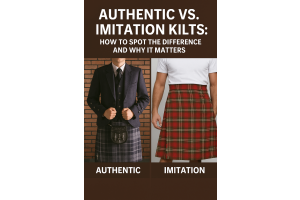
A formal kilt is a kilt paired with a formal torso. The torso is consists of a jacket, a vest, a dress shirt, and a tie. The tie is optional to wear, allowing the wearer to look more relaxed while looking professional. To make it more authentic, a pair of gillie brogues to replace loafers and dress shoes. Mainly there are two styles of the kilt jacket that help created formal kilt fashion.
The Jacket of Prince Charlie
In 1745, Charles Stuart Edward became the leader of the Jacobites, a rebellion group who supported the exiled Catholic King James VII of Scotland and II of England. His nickname, Bonnie Prince Charlie was based on his youthful appearance and his grateful charm. With his Scottish supporters, he made them wore a coat along with their kilts as their military uniform, making them refer to as coatees.
This jacket became known as the Prince Charlie jacket. It’s heavily studded with vertically arranged buttons on the front, sleeves, and tails. The coat can be worn with a three-buttoned and five-buttoned waistcoat. The shoulders are decorated with silk braided epaulets. And hanging in front of the kilt is a full dress sporran.
After losing the Battle of Culloden in 1746, these uniforms were seen as a symbol of rebellion. And it led to the Diskilting act of 1747, banning those who wear a kilt. The only people exempted from the rule were Scotsmen who worked alongside the Highlander regime under the British Empire. The ban was repealed in 1782 after many Scotsmen felt oppressed by it.
The Prince Charlie jacket is strictly a formal kilt jacket. It can be used for many social events and special occasions such as weddings, ceremonies, and dinner parties. It is sometimes called a kilt tuxedo for mostly being seen worn at black-tie events.
The Jacket of Argyll
During the 19th century, kilt jackets made a comeback but for more casual wear in the countryside. Many were designed for competitive and relaxing outdoor activities such as hunting, fishing, and hiking. Most Victorian men wore a doublet, a padded sleeveless jacket, and a sack jacket with their kilts. This combination later created a hybrid that led to the invention of the Argyll jacket.
The Argyll jacket is adapted to wear both formally and casually during night and day events. The buttons are arranged onto the pocket flaps and the gauntlet-styled cuffs. Epaulets are optionally attached to the shoulder and can appear to be braided. It can be worn with a five-buttoned waistcoat during the evening, and it can be worn without one during the daytime. The jacket can be paired with either a semi-dress sporran for casual events and a full dress sporran for formal events.
The jacket is best worn formally and casually for outdoor events. Argylls are more flexible and comfortable than the Prince Charlie jacket thanks to being made out of tweed.
The Ghillie Brogues
Aside from the jackets, another part of the formal kilt has added more formality and authenticity. It improved its footwear. Specifically, a pair of the ghillie brogues.
The ghillie brogue was an upgrade to the traditional brogue. The shoe removed the tongue, allowing itself to dry quicker, including the sock. It was designed to easily tread through the wet weather of Scotland's countryside. You can identify them by their shoe tip by the shape of a W wing. They are very useful for any social events when walking in and out.
The Tartan’s Meaning
The last secret of the formal kilt is the tartan pattern. After the Diskilting of 1747 was repealed, there was a trend in different tartan patterns and colors. In Scotland tradition, your tartan pattern represents your connection to a clan or your loyalty to Scotland. Today, there are about 500 Scottish clans.
The best example can be found way back in 1822 when King George visited Scotland. His advisor was a great Scottish historian and author named Sir Walter Scott. He popularized the idea of the Highlander life, including the men wearing their kilts to show love for Scotland in his book series, Waverly Novels. Scott advised the king to wear Royal Stewart tartan as its colors represented the monarchy and wearing it to show respect.
Your clan doesn’t have to be anyone that is blood-related or related by marriage. For over 500 years, no set of rules established that your clan should be a male member of your family. Any man you invite to your family reunions, weddings, and ceremonies can be any man you honored, trust, and love. That includes the clergyman you hired to help bind your marriage.
The kilt isn’t the only part of the outfit that can have the tartan. Previously, your tartan will need to match the solid colors of your tie and flashes. Rentals now have an additional option for your tartan to printed on them for balance. And for a bonus, a clan crest can be printed on the pin, cufflinks, the sgian dubh, and the belt buckle.
Our Mission
For over 6 years, we at Kilt Rental USA have been dedicated to giving our customers quality formal kilts. As a family-owned business, we can help you find your husband’s or your Scottish heritage in the packages we provide in our rental.
To check out our tartan, accessories, and jacket collection, contact Kilt Rental USA today.