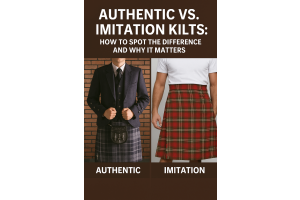



Not sure how to wear a kilt? That's okay, we're here to help!
Whether kilt fashion is totally new to you or you've been wearing them since you were a child, kilts and all of their accessories can seem daunting. Wearing everything correctly is important to Scottish heritage and culture, so if you're going to dress the part, you have to do it right.
We've created an easy guide so you can rock your kilt and all of its accessories.
Let's start with the basics.
-
The kilt
The kilt is the most important part of the whole outfit. Make sure it is wrapped around your body with the pleats in the back and the aprons overlapping each other in the front. The fringe on it should be on your right-hand side. Also, kilts are meant to be worn high on the waist. It should sit above your belly button and its length should reach the middle of your knee.
-
Shirt and tie
There are three basic types of shirts that can be paired with your kilt:
1. The ghillie shirt
This is a traditional, loose-fitting shirt that you wear without a tie. There is leather lace in the front of the shirt that can be tied in a knot to keep it secure around your body. Or, if you prefer, you can keep the laces loose and hanging.
2. Standard collar shirts
When you combine standard wing collar shirts with bowties, they create a formal kilt outfit. If you are wearing this outfit for a daytime event, you can style it down with a straight neck tie for a more casual look.
3. Victorian collar shirts
These shirts are very formal. You can pair them with a bow tie, a ruched tie, or a cravat. If you're going to a wedding or other form event, this is the shirt you should wear.
Keep in mind that no matter which shirt you choose, you should keep it tucked into your kilt.
-
Jacket and vest
Typically, you want to wear a three or five-button waistcoat with your kilt. Or, if you're going with a very formal look, you can choose the traditional jacket and vest combination. Either way, your jacket should match the colors in your kilt. Keep your jacket open to show off its shining buttons.
-
Accessories
Now, let's get into the accessories. Each one of these accessories is part of traditional Scottish attire.
-
Belt and buckle
The buckles and belts on kilts are always wider than normal ones. Remember, you only need to wear a belt and buckle if you choose not to wear a waistcoat. You don't need to wear all three of those items together. The belt is worn through the kilt loops in the back and it is fastened in the front.
-
Sporran
There are three main types of sporrans the Scottish usually wear.
1. Full dress sporrans
These sporrans are the most formal. They are normally embellished with fur and have decorated tassels at the top. They are made from pewter or silver and they usually have Scottish symbols on them to show Scottish pride. They are pretty large, and you can carry some of your belongings inside.
2. Semi dress sporrans
Semi dress sporrans are less formal, but can still be worn to important events. They have a fur front and are made of leather. The flap usually features Scottish symbols and badges.
3. Day/leather sporrans
These sporrans are very casual and can be worn in your daily life. They have a simpler design and are made completely from leather. Scottish symbols are still displayed in the leather front.
-
Fly plaid and brooch
A fly plaid is supposed to match your kilt and it is worn over your left shoulder. It adds something special to your outfit and will make you stand out in the crowd. You can secure it to your shoulder using a brooch. Of course, if you have a Scottish symbol brooch, that would work perfectly, but you can choose any brooch that you think goes well with your outfit.
-
Kilt pin
The kilt pin is meant to be both decorative and purposeful. It adds something special to your outfit, but also keeps the front of your kilt from flying open in a breeze!
-
Flashes
Flashes are supposed to be worn on the side of the calf, as they keep your hose from falling down. They are perfect for adding some extra color to your outfit. You can choose a flash that either matches your kilt or that is a complimentary color - whatever works for you.
-
Hose
Just like all of the other accessories, your hose should complement the color of your kilt and jacket. You can choose a solid color, or go with a Scottish design. Your hose should reach the bottom of your knee and you should keep the top of then folded down.
-
Sgian dubh
If you're going for a historical look, a sgian dubh is exactly what you need. You can tuck it into your hose at the side of your leg. The top of its handle should stick out from the top of your hose.
-
Brogues
Last, but not least, the brogues. They are essential because no kilt outfit looks complete without a pair of traditional shoes. There are both formal and semi-form brogues, and if you're going for a casual look, you can just wear boots instead. Keep the laces pulled tight and wrap them around your calves before tying them.
Learn more about wearing a kilt!
If you still have questions about wearing a kilt outfit, don't worry, we can help. Check out our collection of kilts and accessories so you can see everything for yourself. Because there are so many pieces to a kilt outfit, it helps to see everything so you can visualize how it will look when you're wearing it. We have a variety of different options that you can choose from so you can look great on your special day.